
Consent
Public consent cannot mean voting every few years while major national questions are treated as technical management.
The Hollow State is a book by Richard Russell about the gap between democratic consent and actual power in Britain.
Governments change. Promises change. Slogans change. But the machinery underneath often keeps moving in the same direction.
A public explanation of why democratic consent often fails to become effective direction.
For serious readers, journalists, MPs, civil servants, business leaders and politically engaged voters.
To move beyond another change of management and toward a democratic reset.
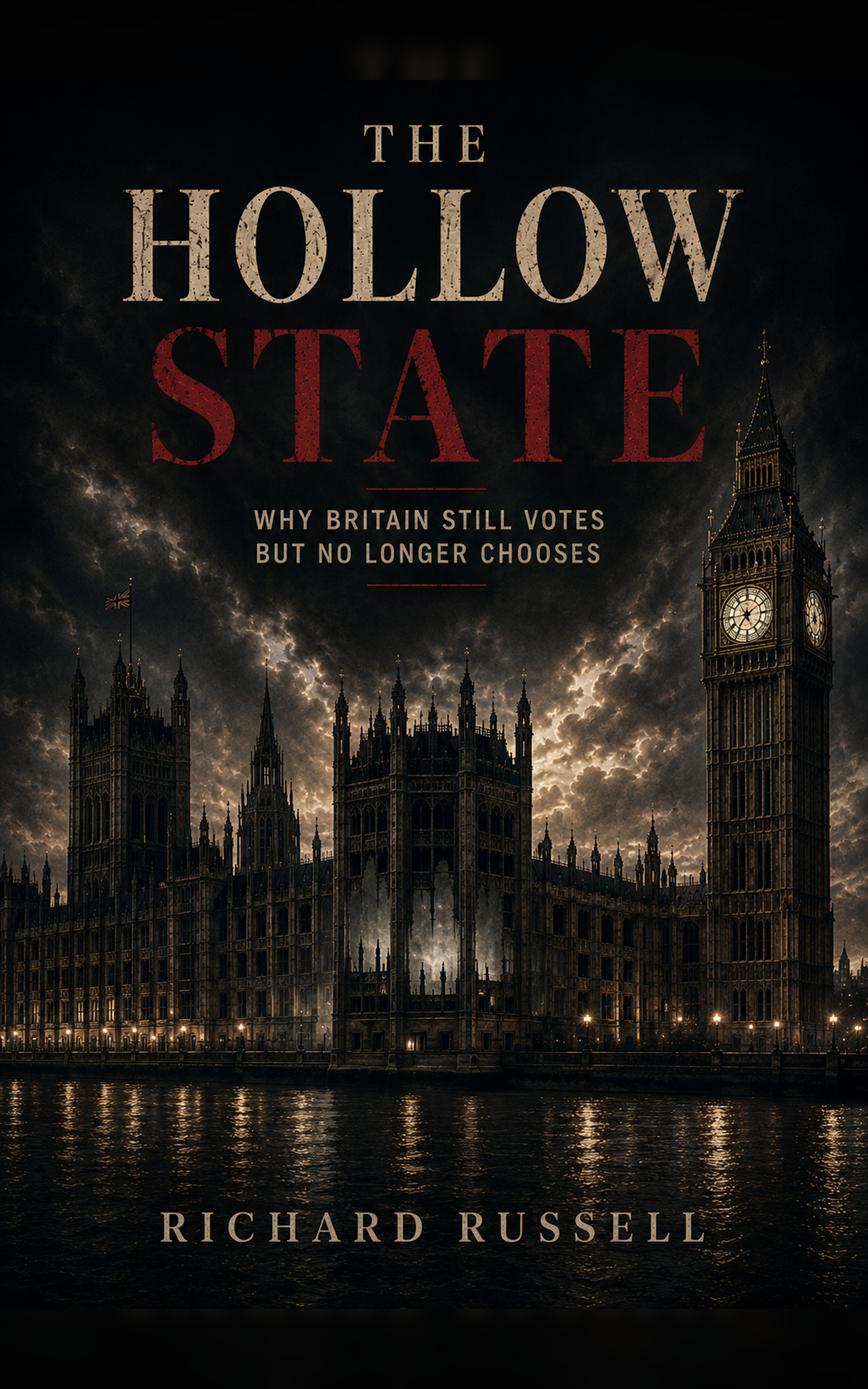
A hollow state keeps the visible architecture of democracy while the substance thins out behind it. Elections continue. Parties compete. Governments are formed. But mandates are absorbed by Whitehall process, quangos, regulators, courts, inherited commitments, international obligations, expert systems, party management and political caution.
The forms remain recognisable: elections, manifestos, cabinets, parliaments and public debate.
The practical room for direction narrows, leaving mandates diluted, deferred or redirected.
The hollow state does not abolish democracy. It absorbs it.
The book examines the gap between electoral legitimacy and governing capacity, and asks what meaningful democratic correction would actually require.
If citizens can change the management but struggle to change the machine, public consent becomes thinner, accountability weaker and correction harder.
Public consent cannot mean voting every few years while major national questions are treated as technical management.

A serious democracy cannot survive if power is protected from consequence.

The public must have structured ways to correct the state between elections.
The Hollow State sets out a reform-minded framework for restoring democratic direction without collapsing into slogans, theatrical plebiscites or digital coercion.

Election promises should not function as disposable rhetoric once power is obtained.

Citizens need practical constitutional tools to stop major decisions that lack clear consent.

Major constitutional or long-term national changes should require direct democratic authorisation.

Evidence used to justify public action should be legible, contestable and open to serious scrutiny.

Where power is exercised without delivery, evasion should not be costless or indefinite.

Technology can widen participation, but must not become an instrument of manipulation, surveillance or synthetic consent.
A mandate without delivery is theatre.
The reform case is not anti-democratic. It is an attempt to make democratic instruction intelligible, durable and actionable.
Household debt is important. But it is not national resilience. Britain’s real balance sheet includes public debt, tax, debt interest, housing costs, productivity, energy prices, public-service capacity and future obligations that eventually land on citizens.
This section is designed for essays, briefings, extracts or media-ready argument summaries. It should remain public-facing, evidenced and restrained.
No unsupported statistics are presented here. Public pages should prioritise clarity, scope and confidence over noise. Further briefings will follow on Brexit as an institutional stress test, energy security, utilities, growth, supply chains and democratic reform.

Journalists, podcasters, reviewers and serious contacts can use the confirmed contact routes below. Richard Russell can currently be reached via LinkedIn and X while a dedicated media workflow is being finalised.
LinkedIn and X are currently the confirmed public routes for media and serious enquiries.
Amazon UK is now available as a confirmed retail destination for The Hollow State. The official front cover is now live, and additional editions, platforms and media assets can be added here as they are released.


